
1st ERCOFTAC Milton van Dyke Competition 2025 - Interview with the Winner
Iván Padilla-Montero
School of Aeronautics (ETSIAE), Universidad Politécnica de Madrid, Spain
"The Regimes of Twin-Jet Flow"
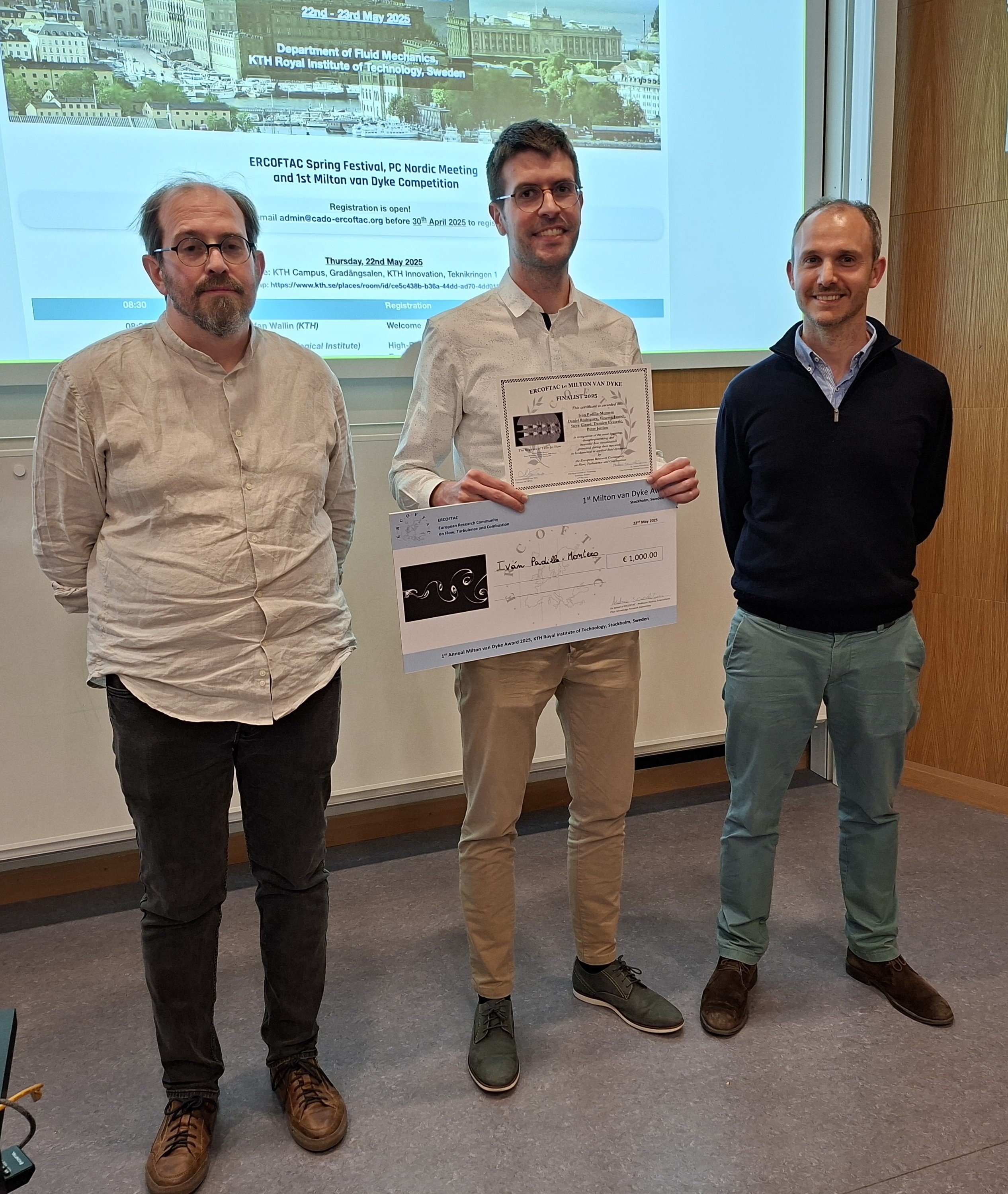
- What does your visualisation show, and what makes it scientifically interesting?
“The Regimes of Twin-Jet Flow” is an experimental schlieren visualization that shows the temporal evolution of the flow generated by two convergent-divergent nozzles as the pressure ratio is progressively increased. The visualisation shows the evolution of the twin-jet flow from the incompressible, low-speed regime to the fully underexpanded supersonic regime, progressively passing through the transonic, overexpanded and perfectly expanded regimes.
Its scientific value lies in the high sampling frequency of the images, which captures the temporal evolution of the turbulent structures in the flow. By employing data-driven techniques to this recording, very valuable information about the dynamics of the twin-jet system can then be obtained.
The visualisation also offers a pedagogical value, as it is a very rich example to showcase compressible flow phenomena such as shock and expansion waves, shear layers and acoustic waves.
- How was this visualisation captured/created? What techniques or methods did you use?
The experimental data was captured at the PROMETEE laboratory of Institut Pprime, in Poitiers (France), during a visiting research stay that I performed. Obtaining this recording was possible thanks to the group of Prof. Peter Jordan and the research engineers working at the PROMETEE laboratory, who designed the wind tunnel, twin-jet configuration and optical hardware.
The experiment consists of two convergent-divergent nozzles subject to a variable nozzle pressure ratio and a constant total temperature. The pressurized flow in the laboratory is supplied by a 200 bar compressed air network. The optical setup is a classical Z-type schlieren system which incorporates a Phantom v2640 high-speed camera.
The visualisation was created by recording the flow during a nozzle pressure ratio ramp-up for a total duration of 1 second, progressively increasing the isentropic jet Mach number from 0 to 2.
- What does the Milton van Dyke Prize mean to you, and what does being a finalist/winner mean to you?
I feel this prize is a recognition to the will of sharing exciting fluid mechanics phenomena with others, which also reflects the passion we put when designing numerical calculations and experiments and our curiosity when interpreting the results. Being the winner of the 1st Milton van Dyke Prize is a great honour for me, and I am very grateful to my postdoc supervisor, Prof. Daniel Rodríguez, and to the team of Prof. Peter Jordan at Institut Prime for this achievement.
- How does visualisation contribute to understanding complex fluid mechanics in your research area?
Besides the information that the schlieren visualisation gives us about the compressible inviscid structures in the flow (shock and expansion waves), the spatio-temporal coherent information embedded in this recording can reveal novel understanding on the dynamics of turbulent twin-jet flow. Data-driven techniques both in the time and frequency domains can extract the shape and frequency of large-scale organized structures in the flow, the types of oscillation in which the two jets can couple and how the system switches from one to another. Understanding these mechanisms allows us to advance towards controlling jet flow and eventually reducing jet noise, which is often the ultimate goal.
- What triggered your interest in fluid mechanics/computational mechanics?
As a kid I always liked aircraft and spacecraft and since very young I wanted to study aerospace engineering. I believe my passion for aerodynamics triggered my interest in fluid mechanics.
- What motivates you in your work?
l am driven by curiosity and the beauty of compressible flows and seek new fundamental understanding of high-speed flow phenomena.
- Where do you see yourself in five years?
I recently started working as an assistant professor at Universidad Politécnica de Madrid (UPM), and within 5 years I would like to see myself building a research team at UPM to work on the stability of turbulent high-speed flows.
- Do you have any advice for others in STEM/fluid mechanics?
I think it is very important to be resilient while pursuing your goals. If you are passionate about a topic, even if not popular or even if it feels that no opportunities are near you, stay true to what you like and avoid being discouraged by others. This will allow you to do good work that will attract positive interactions and will pay off.
- What advice would you give to early career researchers about the importance of visualisation in communicating science?
I believe visualisation is extremely powerful in communicating fluid mechanics results. Fluid flow in air is almost always invisible and our intuition is not trained to imagine it. Visualisation is a fundamental tool in helping us consolidate theoretical results that we study and learn, which are sometimes counter-intuitive, and is a much more effective way to communicate new understanding to others. I would encourage anyone to use it after achieving a critic interpretation of the physical phenomena being displayed. Within fluid mechanics, we nowadays face the challenge of having many statistical techniques that can generate beautiful images from data, but it is our responsibility to assess the scientific soundness of these images to avoid communicating unphysical results.
- What was it like presenting at the ERCOFTAC Spring Festival?
It was a very rewarding experience to meet and attend presentations from many important researchers in the field, which are often a reference for my own work. Getting to know the KTH Royal Institute of Technology for the first time was also very gratifying.
- What will this recognition mean to your career going forward?
I believe this recognition will allow me to expand my research network and grow my independence as a researcher, both through participating in international research projects and future ERCOFTAC events.
 Pilot
Pilot Special Interest
 Knowledge
 ERCOFTAC