


Oriol Lehmkuhl
Barcelona Supercomputer Center, Spain
"On the discovery of novel flow control strategies for external aerodynamics by means of deep-reinforcement learning and supercomputing"
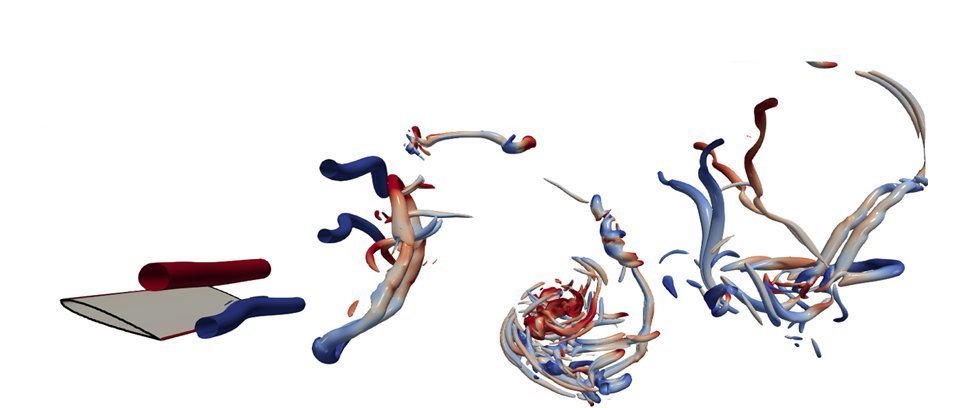
The discovery of effective active flow-control strategies for external aerodynamics remains a central challenge in fluid mechanics, particularly in turbulent, three-dimensional, and massively separated flows. In this keynote, recent advances demonstrating how deep reinforcement learning (DRL) can autonomously uncover non-intuitive, broadband, closed-loop control laws that outperform classical periodic and model-based strategies, will be presented. By coupling DRL agents with high-fidelity large-eddy simulations, we show that learning directly from the flow enables the emergence of coherent, physically interpretable control mechanisms, including the manipulation of large-scale vortical structures and separation dynamics across a wide range of temporal and spatial scales. These results illustrate how data-driven control can move beyond parameter tuning toward genuine discovery of new aerodynamic control paradigms.
A key focus of the lecture is the translation of these ideas to realistic three-dimensional configurations and relatively high Reynolds numbers, where classical optimization approaches become impractical. We will discuss recent results on bluff bodies, turbulent separation bubbles, and flow-separated wings, highlighting how multi-agent reinforcement learning and distributed actuation allow scalable control in strongly turbulent regimes. Despite being trained in highly constrained numerical environments, the learned strategies exhibit remarkable robustness, smoothness, and physical consistency, conserving momentum instantaneously while exploiting a wide spectral bandwidth inaccessible to conventional forcing. These findings challenge long-standing assumptions in active flow control and open new avenues for physics-guided interpretation of learned policies.
Crucially, such progress would not be possible without advances in high-performance computing and software co-design. The keynote will therefore emphasize the HPC dimension of DRL-based flow control, including solver-agnostic coupling, asynchronous in-memory communication, GPU acceleration, and massively parallel training across thousands of environments. By leveraging modern supercomputing architectures, DRL training times are reduced from prohibitive to more practical, enabling exploration at unprecedented fidelity. This convergence of AI, CFD, and pre-exascale computing marks a decisive step toward autonomous aerodynamic optimization and sets the stage for future deployment in industrial-scale external aerodynamics.
Biography
Dr. Oriol Lehmkuhl is a lead researcher (R4) at the Department of Computer Applications in Science and Engineering (CASE) at BSC. He holds a Ph.D. in Mechanical Engineering from UPC. Dr Lehmkuhl is Ramon y Cajal researcher and leads the Large-scale Computational Fluid Dynamics group at BSC and has been recently granted with an ERC Synergy. He has been the co-director of 20 PhD theses (11 of them on-going) and 15 master theses, is author of 93 papers in JCR journals (h-index 34), with about 220 contributions to peer-reviewed international conferences and 4 patents. In addition, Dr. Lehmkuhl has been involved in 30 national and EU supported projects (5 as coordinator) and has participated in 40 RES research projects, 6 Tier-0 PRACE projects and 1 INCITE project. Dr. Lehmkuhl's main research interests are turbulence modelling, multi-phase modelling, high-performance computing, multi- physics & multi-scale modelling, aerodynamic simulations, and bio-mechanical modelling.