



Pedro Costa
Technische Universiteit Delft, The Netherlands
"Compute-rich alternatives for direct numerical simulation of complex turbulent flows"
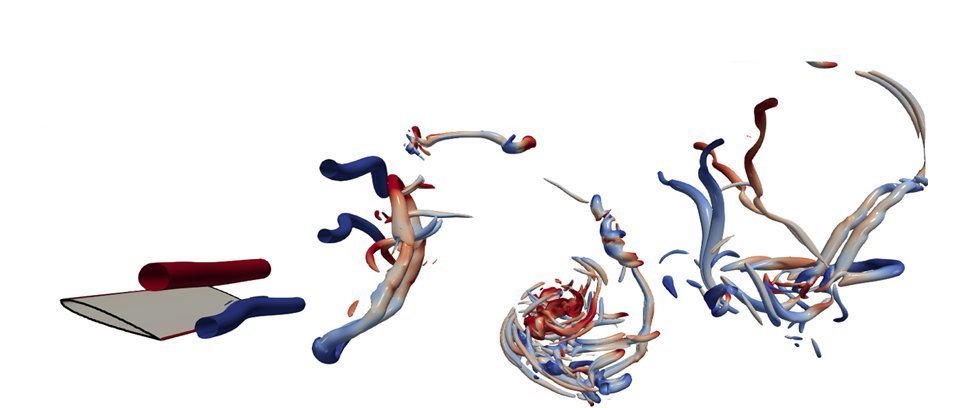
Scientists and engineers who depend on large-scale computations must adapt to a shift in computing architectures, which are increasingly tailored to artificial intelligence applications. This makes it challenging for computational fluid dynamics to continue exploiting ever-growing computing power efficiently. Despite this, the benefits of adaptation are compelling: one can reveal, with unprecedented detail, the dynamics of complex fluid flows in applications related to climate and the energy transition. In this lecture, I will discuss how we adapt numerical methods to modern hardware by developing new formulations whose key building blocks are accelerator-efficient kernels well matched to these platforms. I will then illustrate how extreme-scale computing has enabled us to address outstanding research questions in convective and multiphase turbulence.
Biography
Pedro Costa is an Assistant Professor at the Process & Energy Department of the Mechanical Engineering faculty at TU Delft. He earned his PhD in the same department by the end of 2017, for work on dense turbulent suspension flows. Before joining the department in late 2022 in his current position, he spent a postdoctoral period at KTH Mechanics in Sweden and the University of Iceland, where he investigated dispersed turbulent multiphase flows using interface-resolved simulations and developed fast numerical algorithms and solvers that have been adopted within the DNS/LES community. His research interests include turbulent particle suspensions, convective turbulence, phase change, interface-resolving simulations, fast numerical solvers, and high-performance computing.